Egypt's balancing act in a fragmenting world

Updated: Nov 21, 2025
What interests are at stake in a changing political game
As global order fragments into overlapping centers of power and arenas of influence, the capacity for a state to mediate, balance and adapt are highly strategic. In this respect, Egypt is becoming an essential actor in the emerging multipolar order. Medium-sized powers, such as Egypt, are using this shift as an opportunity to play off greater powers against each other and are using their strategic geography, alliances and regional interests as leverage.
At the crossroads of Africa, Europe and Asia, Egypt has long performed this careful balancing act. In today’s shifting landscape, it is becoming one of the most sought-after partners for regional and global powers alike. The world around it is not breaking apart but into blocs of East and West as before, rather as Dutch analysts Ruth Mampuys, Corien Prins, Haroon Sheikh and Paul ’t Hart (2025) argue, fragmenting and re-forming: power is spreading across new centers, geopolitics now shapes trade and technology, and non-Western worldviews have gained political weight. In this environment of overlapping blocs and rival ambitions, Egypt’s ability to balance interests and alignments reveals how a mid-sized state navigates a world no longer organized around a single (or two rivalling) pole. Emerging states such as Egypt are balancing their values, of which most importantly their autonomy, with their strategic interests. The latter often takes the shape of dependency. Using shared partnerships and international organizations as starting points for negotiation and cutting lucrative deals only goes so far. To have a better understanding of how Egypt is operating in this changing balance of powers, we must zoom in on its interests and goals, regionally and globally.
The domestic state of affairs
Egypt enters this new era burdened by domestic fragilities that inevitably shape how it sees the world, and in turn how it is perceived by the world. A decade of economic struggle, currency devaluations, rising debts, and youth unemployment has narrowed the government’s room for manoeuvring. The Egyptian population is growing faster than jobs and water supplies; subsidies are shrinking even as living costs rise. Politically, the regime’s grip on stability depends on constant inflows of foreign loans and revenues from multilateral projects.These constraints make foreign policy a means of survival. Cairo’s search for investment, aid, and diplomatic prestige is therefore inseparable from its internal balancing act between economic needs, political control, and public expectations.
For Egypt, the fragmenting world order offers both risks and opportunities. The end of unipolarity means fewer guarantees but also more partners to court, more arenas to influence and more leverage to extract from its strategic geography. How Egypt positions itself amid these overlapping blocs will determine whether it remains a regional influence or becomes a peripheral actor in a crowded multipolar system. Over the past decade, Egypt has eliminated many of the threats that once defined its internal politics. The Muslim Brotherhood, for long the country’s most organized opposition force and rooted in both religious activism and social welfare networks, was outlawed after 2013. The state had succeeded in dismantling a movement that had challenged state authority since the 19th century and had considered it an existential threat. With the Brotherhood crushed and organized dissent subdued, Egypt’s main challenges are no longer ideological but structural. The economy remains under continuing strain with high unemployment and growth depending on state-driven construction megaprojects. The country’s finances rely heavily on foreign loans and investments from China and the Gulf. As the Clingendael Institute (2025) observes, this model offers only short-term relief. The construction sector provides immediate visibility and political legitimacy but in turn produces only limited employment and productivity gains. All the while Egypts dependence on external partners, in particular China remains growing. Egypt’s attempt to diversify into ICT nearshoring and digital services hints at a more sustainable path but this transition seems to be slow and uneven. With limited possibilities in the near future for domestic reform, foreign policy becomes a vehicle for economic strategy, securing capital, adopting new technologies and political validation.
These internal pressures shape how Cairo views a changing global landscape. As Mampuys, Prins, Sheikh and ’t Hart argue, the world is not descending into disorder but rather it is fragmenting: power is dispersed among multiple centers as opposed to the unipolar world order we have come to know over the past three decades, geopolitics now permeates trade and technology and alternative worldviews challenge Western liberal dominance. For Egypt, this fragmentation blurs old hierarchies and creates new openings. Surrounded by rival powers competing for access to the Suez Canal, the Red Sea, and African markets, Cairo is looking to turn vulnerability into leverage while balancing between blocs to secure its survival and relevance in a world without a singular pole of power. Egypt’s economic structure does more than strain its domestic stability, it defines how the country positions itself in an increasingly fragmented global system. Three intertwined weaknesses (low employment, an unsustainable reliance on construction and raw materials and chronic dependence on foreign loans) shape Cairo’s path in search for partners.
Low employment keeps Egypt locked in a cycle of social fragility. Each year, hundreds of thousands of young Egyptians enter a job market that cannot absorb them. This demographic pressure pushes the government to seek foreign investment that can generate quick employment gains, with the source of investment being of lesser importance. In a world where power is dispersed among multiple centers, Cairo does not have the luxury of ideological alignment that it has had in some periods of its recent history. Gulf money, Western aid, and Asian capital all become equally acceptable if they create jobs - and they certainly do. Egypt’s openness to competing investors, whether they be Saudi, Emirati, Chinese, European, fits neatly into a fragmenting order built on selective and issue-driven partnerships rather than bloc loyalty. Super powers that rely on Egyptian regional influence and access to the Suez canal in turn could possibly leverage this non-aligned stance in their foreign policy regarding Egypt.
The overreliance on the construction sector deepens this dynamic. Mega-projects like the New Administrative Capital, which are financed and often built by mainly Chinese firms, have delivered short-term growth and political visibility but few lasting jobs. As the Clingendael Institute notes, this construction-driven model strengthens ties with China while crowding out innovation and private-sector diversification. This too will become an issue Egypt has to face in the near future. In a fragmented global economy, where infrastructure diplomacy replaces ideology, Egypt’s focus on construction ties it closer to Beijing’s development playbook but also signals its main vulnerability: its growth model is dependent on foreign contractors and imported finance.
Finally, Egypt’s dependence on foreign loans and investments converts domestic weakness into diplomatic necessity. IMF programs, Gulf deposits at the Central Bank and Chinese credit lines give foreign partners a significant leverage. Yet this dependence also explains Egypt’s behavior in a world without a single dominant power: instead of aligning with one patron, Cairo cultivates many. By borrowing, trading, and partnering across rival spheres, it transforms necessity into strategy and manages to extract support from every pole of power.
These economic patterns place Egypt at the intersection of the fragmenting world order described by Mampuys, Prins, Sheikh and ’t Hart: a system defined by multiple power centers, the return of geopolitics to trade and finance and competing (sometimes clashing) worldviews. Egypt’s fragile economy both exposes and empowers it. It is forced to act as a pragmatic broker in a landscape where dependence and influence coexist. Though the domestic dimension will be the leading cause for most states' behavior on the world stage, Egypt is surrounded by external questions that need answering.
Africa: Upstream Power, Downstream Tension
One of the most important areas of attention for Egypt is one that flows down from Addis Ababa. Ethiopia’s ambitions on the Nile have become the defining test of Egypt’s African diplomacy. Ethiopia frames the Grand Ethiopian Renaissance Dam (GERD) as an assertion of its sovereign development rights over a river that for long was governed by colonial-era treaties (1929 and 1959). These treaties heavily favored the states downstream. Through controlling the pace of filling and operation of the river, Ethiopia seeks to secure water and energy sovereignty. In doing so it could transform itself into Africa’s largest power exporter with over 6,000 megawatts to sell electricity to Sudan, Kenya, Djibouti, and eventually Egypt, too. The dam is part Ethiopia’s broader vision of becoming an African power center by leveraging its geographic and institutional assets: the African Union headquarters is in Addis Ababa, it has a large and growing economy and has strategic backing from both China and Turkey. The government’s recent deal with Somaliland to access the port of Berbera is a clear step in the direction of ending its maritime dependence on Djibouti and would reinsert Ethiopia into Red Sea and Suez geopolitics.
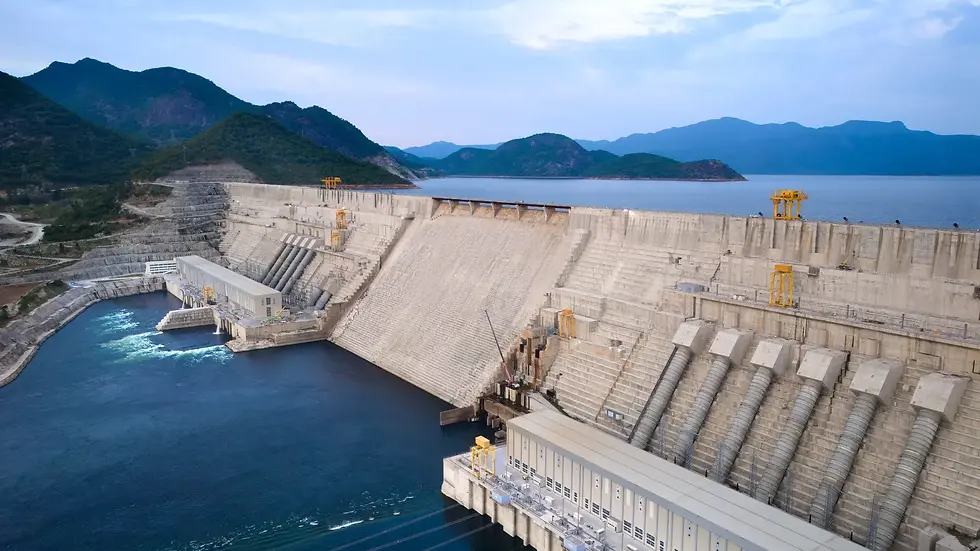
These same ambitions collide with Egypt’s existential vulnerabilities. Egypt depends on the Nile for 90–95% of its freshwater, making any upstream control essentially an issue of national security. Cairo’s goal is to secure a legally binding agreement on the dam’s operation and data sharing to ensure predictable flows as it is located at the very end of the river. Egypt however lacks the hydrological leverage and instead deploys diplomatic tools. It has actively mobilized the Arab League and African Union to isolate Ethiopia and used the EU and UN to press for international oversight. At the same time, Egypt’s broad regional network and participation in bodies like the Red Sea Council allow it to prevent open hostilities that could threaten Suez Canal security or migration stability.
In the context of a fragmenting world order, this rivalry exemplifies how regional power politics now intertwine with global economic and maritime interests. Ethiopia’s rise represents the diffusion of power to new African centers, while Egypt’s response shows how older states adapt through coalition-building and diplomatic balancing. For external actors such as the US, China and the EU, the dispute is not only about water but also about the stability of one of the world’s busiest trade arteries and the political realignment of Africa’s emerging powers.
For Egypt, Sudan is both a buffer and a bellwether. Its territory lies between the Ethiopian highlands and the Egyptian Nile delta, making it the literal midpoint of the GERD triangle and so, crucial to Egypt’s water security. Khartoum’s position on the dam can either shield or expose Egypt to upstream pressures. Sudan also directly influences the Nile’s flow, hosts key confluences and holds land that could serve as a future cooperation or confrontation zone, depending on political alignments.
What Sudan needs most is stability the restoration of basic governance after the collapse of the transitional framework in 2023 and the ongoing conflict between the Sudanese Armed Forces (SAF) and the Rapid Support Forces (RSF). For Cairo, stability south of the border is not altruistic: Sudan functions as Egypt’s primary buffer against both water insecurity and regional chaos. The conflict has already produced over a million Sudanese refugees in Egypt adding social pressure to Egypt’s fragile domestic situation.
Egypt currently provides diplomatic and logistical support to the SAF, calculating that a unified, army-led Sudan would best protect Egyptian interests on the Nile and maintain a familiar authoritarian order. Yet Cairo’s ambitions in Sudan extend beyond water security. It seeks to re-establish a reliable partner that can coordinate Nile management and border control, prevent foreign rivals, especially Ethiopia, Turkey, and the UAE, from dominating postwar reconstruction, secure trade and transit routes linking Upper Egypt to the Red Sea via Sudanese territory and contain migration flows before they reach Egypt’s northern borders, and eventually the EU.
In a fragmenting world order, Sudan’s collapse exemplifies how fragile states can reshape regional hierarchies. Egypt’s policy shows its dual instinct: to stabilize its immediate periphery while avoiding deep entanglement in another open-ended conflict. The aim is not expansion but insulation. By maintaining Sudan as a manageable buffer zone that safeguards Egyptian water, borders and influence without overextending its limited economic capacity.
The Humanitarian Dimension
The war in Sudan has created the world's largest and fastest-growing humanitarian crisis according to the United Nations. Fighting between the Sudanese Armed Forces (SAF) and the Rapid Support Forces (RSF) has devastated Khartoum and Darfur, collapsing state institutions and displacing millions. Over the past 18 months, the civil war has claimed over 150.000 lives. According to UN estimates, by late 2025 over ten million Sudanese have been forced from their homes, and more than one million have crossed into Egypt through the Argeen and Qustul border posts. Cairo, already under economic strain, now faces the challenge of managing an influx of refugees that outnumbers its formal asylum infrastructure. The government allows many to enter on temporary permits but most receive little organized support beyond overstretched host communities in Aswan and Cairo.
For Egypt, this humanitarian crisis has direct strategic consequences. It reinforces the urgency of stabilising Sudan—not only to stop further refugee flows but also to prevent the conflict from disrupting Nile cooperation or spilling violence northward. At the same time, it gives Cairo new leverage with European partners, particularly the EU, which views Egypt as a frontline state for migration containment. The refugee situation thus becomes both a burden and a bargaining tool: evidence of Egypt’s role as a regional stabilizer, but also a reminder of how humanitarian crises now intersect with the geopolitics of aid, migration, and border security in a fragmenting world order.
Africa’s multilateral organisations, the African Union (AU) and the Common Market for Eastern and Southern Africa (COMESA), offer Egypt both a platform and a constraint. As global structures transform and regional institutions gain relative weight, Cairo uses its African memberships to anchor itself in a more multipolar system while counterbalancing dependency on the Gulf and Western partners to varying degrees of success. Fragmentation is rewarding of regional initiative and Egypt does so through their participation in the AU and COMESA. These vehicles give it visibility and a chance at continental coordination. By leaning into an African identity it wins regional legitimacy, positions the state as a bridge between North-Africa, Sub-Saharan African and the Arab world and provides Egypt with a stage on the border of all three to make it into a new center of power. Likewise, Egypt functions as the gateway for trade between three continents, benefitting the Suez canal revenues and through COMESA allowing Egypt access to a market of over 500 million people. If Egypt finds a way to merge its protectionist tendencies with COMESA's relatively liberal trade agenda, it could prove itself Africa's major arena of power. Using both the AU and COMESA to remain economically and politically center stage in a decentralized system will likely be climbin up on Egypt's strategic agenda in the near future.
The Gulf
Another medium-sized power that seeks autonomy within the shifting power centers is Saudi Arabia. The relationship between Saudi Arabia and Egypt is marked by their shared vulnerabilities and ambitions, rather than a pan-Arab identity. Fragmentalization and the decline of clear US dominance makes way for both medium-sized powers to enhance and expand their spheres of influence. Both states view regime stability as a priority, supporting autoritarian models of governance across the MENA region. For both Saudi Arabia and Egypt the Red Sea, specifically Bab al-Mandab, is one of their main arenas of (competing) power. Both want to counter Iranian and Houthi influence and want to protect shipping routes for themselves and global trade. Both states understand the importance of good relations between them: Egypt's regional, cultural, religious weight and access to trade routes is indispensible to Saudi Arabia. The Kingdom also stands to gain much from stable footing on the Africa continent as this gives it the necessary legitimacy. In turn, Saudi investments, labor opportunities and tourism offer Egypt a lifeline in economically challenging times, as well as an opportunity to diversify its overreliance on the West and China. Their interests diverge though not far from this. Saudi Arabia is setting itself up to be the Arab heavyweight in the regional while Egypt sets out to be a Arab heavyweight. The same areas of shared interests become the background for regional tension: leadership over security in the Red Sea area, Saudi Arabia's Africa policy and Egyptian religious and cultural influence become tools with which both states behind the scenes actively compete against one another.
In a fragmenting global order where power is dispersed across regional centers, Egypt and the United Arab Emirates (UAE) have built one of the Middle East’s most coherent partnerships; anchored in shared authoritarian stability, economic interdependence, and mutual ambitions across Africa, the Red Sea and the Mediterranean. Both states champion a state-driven, anti-Islamist governance model and have cooperated to contain political Islam in Libya, Sudan and elsewhere. Their economic complementarity reinforces this alignment: Egypt relies on Gulf capital and investment from Emirati sovereign funds and firms such as ADQ, ADIA, Mubadala, DP World and Masdar, while the UAE depends on Egypt for food security, labor and maritime stability. Together they function as a regional mini-bloc pursuing influence in the Red Sea, the Horn of Africa, Libya, and emerging African markets. These are arenas that are increasingly shaped by regional, not global, powers.
Despite this cohesion friction, of course, persists. The UAE’s rapid normalization with Turkey contrasts with Egypt’s cautious stance; Emirati ventures in Ethiopia, Somaliland and Sudan sometimes clash with Cairo’s Nile-centered security priorities; and UAE advocacy for privatization and structural reform often collides with Egypt’s military-dominated political economy. These differences are magnified by growing scrutiny of Emirati behavior in Sudan, where United Nations investigators deemed credible the allegations that the UAE supplied or facilitated arms transfers to the Rapid Support Forces (RSF). The UN panel based its assessment on evidence of UAE-linked vehicles and weapons in RSF-controlled areas, documented supply routes through Chad and corroboration from independent monitors. Abu Dhabi has categorically denied the charges, claiming the panel mischaracterized its findings. Nonetheless, the controversy exposes the risks of the UAE’s activist regional posture. One that overlaps with Egyptian interests in countering Islamists but diverges over the balance of influence along the Nile corridor.
For Egypt, the UAE remains a vital financial stabilizer, political backer, and gateway to global capital; for the UAE, Egypt offers demographic depth, strategic geography, and Arab-African legitimacy. The decline of a single global authority has amplified their partnership, allowing both to act as mutually reinforcing medium powers that project order, secure trade routes and shape outcomes from the Red Sea to North Africa even as controversies like Sudan reveal the tension between regional influence and accountability.
The relationship between Qatar and Egypt is best characterized as one of pagmatism. This fits neatly into the theory of fragmentalization as it does not incentivize picking sides. For Qatar, Egypt offers another Arabic-speaking market, both economically and reputationally (the Al-Jazeera network perhaps being the most prominent example). Egypt's strategic location is not only beneficial to Qatar in terms of maritime trade but also allows the Qatar to position itself as another negotiating power. It benefits from the very same stability that Egypt is looking for on its nothern, southern and western borders, as well as its Red Sea coast. This has been proven in 2008 with the Doha Agreement and notably in January of this year when both Egypt and Qatar (alongside the US) were able to broker a ceasefire agreement for Gaza. Aside from being a diplomatic heavyweight, Qatar also has an enormous surplus of capital and a strategic desire to branch out their influence into Africa. For this, partial alignment with Egypt is a non-negotiable. Their shared interests do diverge outside of economic and diplomatic terms, though. Where Egypt can find partners that, to some level, it ideologically agrees with in Saudi Arabia and the UAE, Qatar is the clear outlier when it comes to anti-Islamist governance models. Qatar has been a notable supporter of Islamist political actors in North-Africa, specifically the Muslim Brotherhood, both in and outside of Egypt. With Qatar-based members of the Muslim Brotherhood having been accused of aiding terror attacks on Egyptian soil by the government, it is clear that ideologically the two do not align. Medium-sized powers in the MENA region, including Egypt, are still wary of Qatar's influence and political agenda following the Qatar diplomatic crisis. Though the crisis has been resolved through the al-Ula Declaration in 2021, Egypt turned the rivalry into an issue-specific partnership. It is not only Arab states that must be continously on the lookout for Qatar's regional influence, though. Israel, though not aligned with the Arab league, shares this sentiment with them. Since the 7th of October Israel has also been very critical of Al-Jazeera due to its status as a government funded news network.
The relationship between Israel and Egypt is characterized by pragmatic interdependence first and foremost. For both states, security is dependent on the other's ability to contain conflict. This is true for Gaza and the Sinai, but also for the Red Sea corridor and the Eastern Mediterranean. Fragmentation allows both states not to rely on a sole partner but also weakens the support of super powers for them. Neither Israel nor Egypt wants escalation, Israel relies on Egypt to control and prevent militant spillover in Sinai and Egypt relies on intelligence sharing to conduct counterinsurgency operations there.

In a fragmenting world order, where authority and influence are dispersed across multiple centers and arenas, Egypt’s relationship with Israel exemplifies how medium-sized powers use flexible, issue-based cooperation to maintain relevance. Egypt’s leverage lies not in economic or technological strength but in its ability to coordinate—or withhold—cooperation in areas vital to Israeli and regional security. This influence is procedural and situational, emerging in the grey zones between diplomacy, security, and humanitarian management. In Sinai, Egypt’s expanded troop presence—beyond the 1979 Camp David limits but permitted by Israel—depends on constant coordination; by adjusting the tempo or depth of this engagement, Cairo can quietly signal approval or pressure without breaching the treaty. In Gaza, where Egypt controls the Rafah crossing and mediates ceasefires and hostage exchanges, its decisions directly shape Israel’s operational flexibility and international exposure. Cairo’s intelligence cooperation—covering Hamas, Sinai insurgents, and smuggling networks from Libya or Sudan—is similarly discretionary, reflecting the fragmented security environment where coordination replaces hierarchy. Even symbolically, Egypt’s status as the first Arab state to make peace with Israel grants it regional and Western legitimacy: subtle shifts in tone or access reverberate widely. This pattern—selective engagement across overlapping arenas of security, diplomacy, and legitimacy—illustrates how fragmentation rewards states like Egypt that can turn limited assets into adaptive leverage, operating as indispensable brokers in a system with no single center of power.
In a fragmenting world, fortune favors those who dare not to align themselves with one single bloc of power.
The Atlantic
Though not directly bordering on the Atlantic, Egypt has always been important to the US and the EU. In recent years, the dispersion of global power also meant that the relationship between Egypt and the European Union has become more pragmatic and transactional. Both actors face overlapping pressures: irregular migration, energy insecurity, and regional instability across the Mediterranean. Europe’s inability over the past decades to coordinate a unified migration policy and its declining U.S. security umbrella have made Egypt indispensable as a frontline partner. Egypt manages its borders, hosts over a million refugees and acts as a stabilising force along routes leading to Europe. It uses their central role at the crossing of Africa, Asia and Europe to secure political legitimacy and financial support from different (and sometimes competing) benefactors. Since 2022, the war in Ukraine has accelerated Europe’s diversification away from Russian gas, subsequently resulting in Egypt’s importance as an energy hub increasing. It has done so through its liquefied natural gas terminals and participation in the East Mediterranean Gas Forum (EMGF). The blurs the line between trade and security and is a clear example of fragmentation pushing geopolitics into new arenas such as supply chains and infrastructure. Climate and water diplomacy, both highly placed on the European agenda, offer another field of alignment. Egypt’s lead in COP27 and its Nile-basin initiatives complement the EU’s Global Gateway and Green Deal strategies. Nevertheless, the relation remains asymmetric. The EU seeks governance reforms and human rights progress, Egypt prioritizes regime stability and steady financial inflows. For Cairo, ties with Europe are part of their previously mentioned diversification strategy. It balances Gulf and Chinese dependence and maintaining its image as a stabilizer between three continents. From Brussels' point of view, Egypt is both a necessity and a dilemma they face. Egypts presence on the world stage is simply too central to ignore, but also too authoritarian for European terms. In a fragmented order, this relationship cannot be sustained by shared values rather its foundation is converging needs, control of migration flows, energy trade and regional stability. These factors have replaced ideology as the real currencies of influence.
In a fragmenting world, fortune favors those who dare not to align themselves with one single bloc of power. In the case of Egypt, the decline of the United States as the single global power means their relationship has shifted from alliance to managed interdependence. The U.S. still views Egypt as a cornerstone of regional stability and an essential partner for maintaining the Camp David peace framework, securing the Suez Canal and Red Sea trade routes, combating terrorism and managing escalation around Gaza and the Sinai. Yet in an era of dispersed power, Washington’s priorities have broadened beyond the Middle East toward Asia and global system competition with China, creating strategic space that Egypt uses to assert greater autonomy. Cairo continues to rely on American military aid, training and political cover in Western institutions, but it no longer treats the U.S. as its primary guarantor. Instead, Egypt leverages the relationship to reinforce its indispensability—cooperating on counterterrorism, Gaza mediation, and maritime security while diversifying its partnerships with the Gulf, China, and Russia. This dynamic fits the logic of fragmentation: the two states remain linked by necessity, but Egypt calibrates its alignment issue by issue, extracting resources and legitimacy without full policy convergence. For the U.S., engaging Egypt means maintaining influence in a region where American leverage is waning. For Egypt, maintaining the relationship ensures continued military capacities and diplomatic relevance, even as it manoeuvres within a multipolar environment. The result is a pragmatic, conditional partnership that's ultimately rooted in stability and security cooperation. A partnership where both sides recognize the limits of their influence in an increasingly decentralized world order.

Asia
In my previous article the discussion of a changing world order was placed within the context of the Shanghai Cooperation Organization's 2025 summit. But Asian ambitions to diversify and expand their areas of influence are obvious in the MENA region, too. In the Spring of 2025, Egypt and China undertook their first joint air force training 'Eagles of Civilization'. Through the eyes of analytics the message was clear: China is asserting their military dominance and letting us know Egypt does not subscribe to one bloc. Egypt’s relationship with China has evolved into one of pragmatic alignment and mutual benefit. Both states gain from a system no longer dominated by Western influence: Beijing advances its global reach through infrastructure, trade and technology, while Cairo uses Chinese engagement to diversify partnerships and lessen reliance on the United States and Gulf funding. Through the Belt and Road Initiative, Egypt has become a strategic hub connecting Asia, Africa, and Europe, centered on projects such as the Suez Canal Economic Zone, industrial complexes, and new logistics networks. For Egypt, Chinese investment provides much-needed capital to sustain growth and regime stability, even as it risks deepening financial and technological dependence. For China, Egypt offers secure access to the Suez route and Mediterranean markets, along with a politically stable partner in a turbulent region that also finds itself resonating with China's authoritarian character. This partnership embodies the logic of fragmentation: cooperation is flexible, interest-driven, and non-ideological, rooted in shared pragmatism rather than formal alliance. Egypt values China’s principle of non-interference, while Beijing sees Cairo as a useful supporter of South–South cooperation and multipolar governance reforms. Despite the imbalance of power, Egypt uses its geography and strategic relevance to maintain leverage, positioning itself between global actors to extract benefits from each. In this way, Sino-Egyptian relations illustrate how medium-sized and super powers navigate a decentralized order—balancing dependence with agency in a world defined by competing networks of influence.
Further north, Russia finds itself isolated from the world stage. Egypt’s relationship with Russia thus reflects a convergence of pragmatism and strategic necessity. Both states seek autonomy from Western dominance and value flexible partnerships that operate outside traditional alliance structures. For Egypt, Russia provides diversification in arms, energy and diplomacy. While for Moscow, Cairo offers an entry point into the Middle East and North Africa, proximity to key maritime routes and a politically stable partner amid growing isolation from the West. Military cooperation remains central: Egypt continues to purchase Russian hardware and conduct joint exercises, even as Western sanctions complicate logistics. The relationship also extends into nuclear energy, through the El Dabaa power plant and agricultural trade, as Russia is one of Egypt’s primary wheat suppliers. These links have become more important since the war in Ukraine reshaped global supply chains and pushed Moscow to deepen ties across Africa. The emergence of the Africa Corps - Russia’s rebranded network of military and paramilitary partnerships replacing the Wagner Group - underscores this shift. Cairo views it cautiously: while Russian security presence in Libya, Sudan and the Sahel could stabilize areas near Egypt’s borders, it also risks undermining Cairo’s own influence in Africa. Within this fragmented order, Egypt’s approach is calculated: it cooperates with Moscow where interests align, particularly in food security, energy, and regional mediation, but avoids alignment that would jeopardize its relations with Western or Gulf partners. The result is a transactional, multi-layered partnership emblematic of fragmentation itself where Egypt balances engagement with Russia to preserve autonomy and extract strategic gains in a world no longer governed by a single pole of power.
Further south another, another super power is gaining importance. India in many ways is similar to Egypt. Both states navigate between major blocs, preferring flexible, interest-based engagement over rigid alignments. India is increasingly ambiguous in its position in global politics. It maintains its ties with both the West and Russia while also asserting leadership in the Global South. This makes it an appealing partner for Egypt, which similarly is performing a balancing act amongst American, Chinese, Gulf and European interests. The two states share an interest in reshaping multilateralism to reflect southern voices. This is clear through Egypt’s observer role in BRICS and India’s outreach to African and Arab partners through initiatives such as the India–Africa Forum Summit. Economically, India’s expanding technological and manufacturing base aligns with Egypt’s ambition to diversify beyond construction and low-skill sectors. Indian investment and technology transfer in information technology, pharmaceuticals and renewable energy. These are fields that could effectively strengthen Egypt’s drive toward digital transformation and industrial upgrading. At the same time India profits from Egypt’s geographic position and trade agreements with Africa and Europe which offer it a strategic export gateway. Cooperation emerges across overlapping arenas such as trade, technology and energy and allows both states to benefit from explicitly not aligning strictly to a bloc of power. India and Egypt benefit from positioning themselves as mediators between developed and developing worlds, leveraging their size and neutrality to engage multiple partners. The India–Egypt relationship shows us how fragmentation enables mid-level and super powers to use ambiguity and complementarity as instruments of strategy, linking India’s technological and market potential with Egypt’s connectivity and diplomatic reach to carve out space in an increasingly multipolar global system.
Egypt is becoming an influential player in a world where power is no longer held by one dominant bloc but spread across many competing centers. Egypt benefits from its location, its diplomatic ties and its involvement in key regions like the Red Sea and the Nile Basin. These strengths help it work flexibly with different partners depending on the issue. At the same time, Egypt faces major internal challenges: high unemployment, an economy heavily dependent on construction projects and significant reliance on foreign loans. These pressures push Cairo to seek support from a wide range of partners - including the Gulf states, Europe, the United States, China, Russia and India - making foreign policy closely tied to economic survival. Regionally, Egypt must manage security risks in Sudan and Ethiopia while also dealing with cooperation and competition with Saudi Arabia, the UAE, Qatar and Israel. Overall, Egypt’s approach is shaped by pragmatism and a desire to stay independent in a fast-changing world.
Egypt’s future role as a key medium power depends on whether it can turn its balancing strategy into long-term strength. Its geography and partnerships give it important influence, but its domestic weaknesses still limit what it can do. If Egypt uses its varied relationships to support real economic improvement, it can secure a stronger place in the emerging multipolar system. If not, it may remain important but will find itself more influenced by global shifts than actively shaping them.
In the next article, we will take a closer look at the nuclear power balance in the Middle East and how it relates to the fragmentation theory in practice.
Sources
Aboudouh, Ahmed, “Egypt now sees Israel imminent threat.” Chatham House, 2025. https://www.chathamhouse.org/2025/09/egypt-now-sees-israel-imminent-threat
Abdul Hafiz, Mohammed, “Following Egypt-Saudi complete agreement.” Al Arabiya, 27 October 2025. https://www.alarabiya.net/politics/2025/10/27/%D8%B9%D9%84%D8%A7%D9%82%D8%A9-%D9%85%D8%B5%D8%B1-%D9%88%D8%A7%D9%84%D8%B3%D8%B9%D9%88%D8%AF%D9%8A%D8%A9-%D9%83%D8%A7%D9%85%D9%84%D8%A9-%D8%A7%D9%84%D8%A7%D9%88%D8%B5%D8%A7%D9%81-
Al-Anani, Khalil, “Egypt and Iran: A quest for normalized ties amid significant obstacles.” Arab Center Washington DC Resource. https://arabcenterdc.org/resource/egypt-and-iran-a-quest-for-normalized-ties-amid-significant-obstacles/
“عن عواقب التقرّب المصري-الإيراني ومحفّزاته.” Al-Araby. Shaaban, Essam, https://www.alaraby.co.uk/opinion/%D8%B9%D9%86-%D8%B9%D9%88%D8%A7%D8%A6%D9%82-%D8%A7%D9%84%D8%AA%D9%82%D8%A7%D8%B1%D8%A8-%D8%A7%D9%84%D9%85%D8%B5%D8%B1%D9%8A-%D8%A7%D9%84%D8%A5%D9%8A%D8%B1%D8%A7%D9%86%D9%8A-%D9%88%D9%85%D8%AD%D9%81%D9%91%D8%B2%D8%A7%D8%AA%D9%87
Bana, Jalal, “What is really happening between Israel and Egypt?” Israel Hayom (Opinions). https://www.israelhayom.com/opinions/what-is-really-happening-between-israel-and-egypt
Booty, Natasha, Farouk Chothia and
Wedaeli Chibelushi, “Sudan war: A simple guide to what is happening.” BBC News, 4 July 2025. https://www.bbc.com/news/articles/cjel2nn22z9o
Clarke, Ellen, “Instrumental interdependency: The Egypt-Israel gas deal.” International Institute for Strategic Studies (IISS) Online Analysis, October 2025. https://www.iiss.org/online-analysis/online-analysis/2025/10/instrumental-interdependency-the-egyptisrael-gas-deal/
Congressional Research Service, Egypt: Background and U.S. Relations, Report RL33003, updated 2025. https://www.congress.gov/crs_external_products/RL/PDF/RL33003/RL33003.125.pdf
Dessalegn Gedebo, Amanuel, “Egypt’s expanding role in Horn Africa.” Clingendael Report. https://www.clingendael.org/publication/egypts-expanding-role-horn-africa
“Ethiopia accuses Egypt of colonial mentality over dam dispute.” Associated Press (AP). https://apnews.com/article/egypt-ethiopia-dam-nile-river-sudan-water-edd7ec2a31960750baae45b99f1e3d9e
Hassan, Khaled, “Egypt vs. Saudi Arabia: Subtle dispute reshaping Middle East opinion.” Newsweek, 10 October 2025. https://www.newsweek.com/2025/10/10/egypt-vs-saudi-arabia-subtle-dispute-reshaping-middle-east-opinion-2126443.html
India-Egypt Relations, Ministry of External Affairs (India), May 2025. https://www.mea.gov.in/Portal/ForeignRelation/India-Egypt-May-2025.pdf
“Israel uses gas-deal leverage to curb Egyptian military presence in Sinai.” Asharq Al-Awsat (English). https://english.aawsat.com/arab-world/5204816-israel-uses-gas-deal-leverage-curb-egyptian-military-presence-sinai
“Joint Statement between the State of Qatar and the Arab Republic of Egypt.” Ministry of Foreign Affairs of Qatar. https://www.mofa.gov.qa/en/latest-articles/statements/joint-statement-between-the-state-of-qatar-and-the-arab-republic-of-egypt
“Letter dated 8 February 2024 from the Secretary-General addressed to the President of the Security Council.” United Nations Security Council, S/2024/65, 8 February 2024. https://digitallibrary.un.org/record/4039195/files/S_2024_65-EN.pdf
Mabrouk, Mirette, “Egypt and Saudi Arabia: Any good relationship needs work?” Middle East Institute (MEI) Publication. https://www.mei.edu/publications/egypt-and-saudi-arabia-any-good-relationship-needs-work
Mampuys, R., Prins, C., Sheikh, H. & ’t Hart, P., Navigating a Fragmenting World Order : Challenges and Opportunities for the Netherlands, Springer (Research for Policy: Studies by the Netherlands Scientific Council for Government Policy), 1st ed., 2025. https://doi.org/10.1007/978-3-032-00648-6
Morsy, Ahmed, Middle East Council. “مصر وتركيا: تقارب براغماتيّ ومصالح متشّابة.” May 2025. https://mecouncil.org/ar/publication/%D9%85%D8%B5%D8%B1-%D9%88%D8%AA%D8%B1%D9%83%D9%8A%D8%A7-%D8%AA%D9%82%D8%A7%D8%B1%D8%A8-%D8%A8%D8%B1%D8%A7%D8%BA%D9%85%D8%A7%D8%AA%D9%8A-%D9%88%D9%85%D8%B5%D8%A7%D9%84%D8%AD-%D9%85%D8%AA%D8%B4%D8%A7
“مصر وإيران: من الانفـاع والقيود.”Raouf, Hoda, Al Arabiya Arabic. 26 February 2025. https://www.alarabiya.net/politics/2025/02/26/%D9%85%D8%B5%D8%B1-%D9%88%D8%A7%D9%8A%D8%B1%D8%A7%D9%86-%D8%A7%D9%84%D9%85%D9%86%D8%A7%D9%81%D8%B9-
Saleh, Ahmed, CNN Business Arabic, “مصر وتركيا والغـاز والنفـوذ: دبلوماسيّة الأقواس المفتوحة“
Tabikha, Kamal, “Egypt and Qatar cement economic ties with $75 bn investment push.” The National News, 28 August 2025. https://www.thenationalnews.com/business/economy/2025/08/28/egypt-and-qatar-cement-economic-ties-with-75bn-investment-push/
Wahba, Mariam,“Egypt inks multi-billion-dollar energy deal with Israel despite Gaza tensions.” Foundation for Defense of Democracies (FDD) Analysis, 14 August 2025. https://www.fdd.org/analysis/2025/08/14/egypt-inks-multi-billion-dollar-energy-deal-with-israel-despite-gaza-tensions

Comments