How The Trump Stole Christmas

Updated: Sep 17, 2025
Writen by: Manuela Medeiros
As Trump “innovated” with tariffs, hammering China’s market with a 145% tax, the jolly December holiday we all adore now risks arriving late—or not at all. And if it does, well… deck the halls with walls and tariffs!
As this two-sided market war unravels, the ravishing faces of politics and policy stand face to face– ready to throw hands, apply tariffs or ruin Christmas… The tension between nationalist economic policy and global trade dependency becomes clear in the charged words of both sides: "We don't care about sales to the United States,” said Hu Tianqiang, “We can't continue to allow China to rape our country,” said Trump. A maze of assumptions and accusations emerged following Trump's initiation of a two-front trade war with China, accompanied by a staggering 145% tariff increase.
Whilst sugar coating this situation may soften its harsh blow, it is quite the euphemism to say that a large portion of the US's toy industry relies on China's heavy exports– And if that sounds like an exaggeration, let the numbers speak for themselves. The fact is, $13.4 billion of the US's $17.7 billion dollar worth market of toys and trinkets came from China. In other words, as children unwrap their boxes of vivid verdant wrapping, they'll see the gap that devoured 75% of the toy industry as Chinese labor tries to fill the void emerging within the nucleus of global trade, where an emerging gap dichotomizes Chinese vs American imports by a remarkable amount of zeros. As shown in the graph below, even with exemptions, the U.S. still shops at China’s stores like it’s Black Friday—while pretending it’s not.
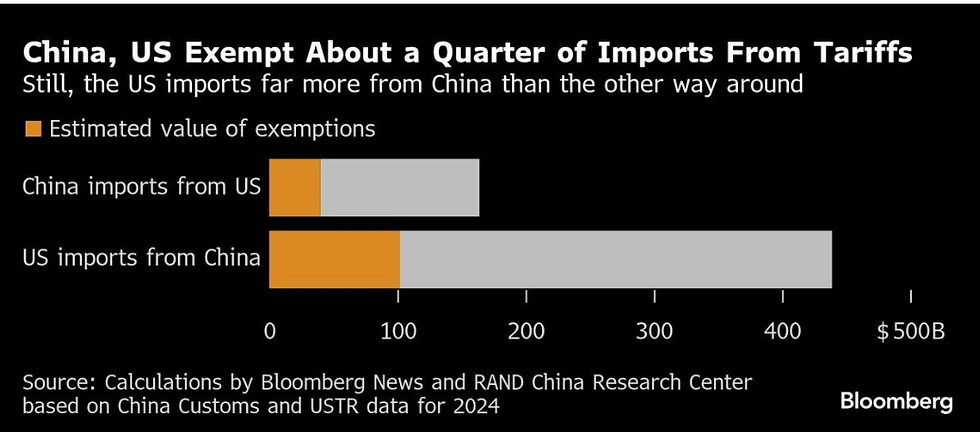
Graph illustrating the disproportionate trade relationship between the US and China, showing that the US imports far more from China despite both countries exempting about a quarter of goods from tariffs.
As an unfortunate haze of misery muddles the toy industry with threat and despair, businesses across the board are left scrambling for solutions. Companies are puzzled trying to untangle the next measures to be taken as Trump applies “reciprocal tariffs” on other nations, they make an effort to apply “reciprocal tactics” in order to keep their commerce on its feet. "This path is catastrophic" says Rick Woldenberg, the CEO of the hand2mind, facturing a whopping amount of $8.6 million per year. For a millionaire CEO, losing a few million may sting, for factories that rely on steady orders to survive, it’s a fatal blow and for families who could once take advantage of buying early on the calendar for a more comfortable price, it's a stab in the back.
However, this disruption isn’t limited to toys alone. Holiday decorations, typically ordered by U.S. buyers months in advance, have also been affected. With April being the usual time orders start rolling in, manufacturers in China have reported little to no demand this year coming from the American motherland. Workers, managers, and the market segment itself find themselves dependent on the US market to sell, as they are responsible for the sale of 50% of Chinese goods. It is undeniable that whilst the Chinese economy serves as an international symbol of economic opulence, it has struggled to stand on its two feet following the restraints set by the pandemic and matters resulting in scarce domestic demand. On a similar note, whilst some Chinese companies bargain with the US to sell their produce to foreign powers, some remain unbothered by the situation, where an attempt to sell to Eastern Europe, Russia, and South Asian countries escalates as a mere response to this feud.
And the effects don’t stop at inventory stalls or slowed sales. A much deeper economic battle simmers beneath the surface. Ostensibly, the finish line of this battle of markets and percentages is nowhere to be seen, and the economy is only one amongst a lexical set of the Chinese situation in regard to the US's “retaliatory” actions. Whilst some lay at home, watching Trump reign over the United States with much havoc and greed, others find themselves baffled by the fact that due to his blunder, they may lose their jobs. Well, it isn't a surprise… After all, high tariffs not only make exported goods more expensive in the importing nation but also significantly lower demand, especially for price-sensitive manufactured goods, leading to production cuts, reduced shifts or even shutdowns. When issues like these are ascendant within a market, factory workers, logistic workers, and those in supply chains are often laid off– where local unemployment spikes are not only evident but start to become common. Furthermore, as China's unemployment rate stands at an arguably comfortable 5.4% of its population of nearly 1.5 billion citizens, Trump's actions have been telling us spectators otherwise.
The real cost of tariffs, however, lies in what follows: layoffs, lost shifts, and shattered livelihoods. ‘They deserved it’, said Donald Trump on an interview for ABC News whereas he confidently claimed the widespread globe was “laughing at us, they thought we were stupid people” – suggesting that these “retaliatory taxes” are nothing beyond an attempt to ‘restore’ the fading memory of America's once prosperous economy and imago, liquidating job opportunities in domestic and foreign land. A mere example of the consequences followed by the intensification of this war lies in the heart of Lehigh Valley– where Mack Trucks, a 125 years old company, announced the lay off of around 10% of its unionized workers at the Lehigh Valley unit– pointing all fingers to tariffs and the economic uncertainty followed by them. “We will be prosperous, we will be proud, we will be strong, and we will win like never before”, is what he promised. And so, when a promise is not satisfied, neither should we– where prosperity, pride, strength, and this propaganda of American triumph hides amidst Trump's facade of innovation, where the President believes tariffs are a solution, the solution.
As previously noted, this issue is far from being a contained domestic matter—it extends beyond national borders with no indication of subsiding. At the China Import and Export Fair, amongst the largest trade shows in the world, patrons from the United States and Europe populated 10% of the total registered onlookers. It may not sound as surprising but after taking note of the 30% decrease since previous fairs, European and American attendance plummeted over the years– a slender forecast of the reduced interest or ability of Western companies to engage with Chinese exporters due to economic slowdowns, inflation, or shifting supply chain strategies. Nonetheless, this drop in willingness to endorse trade with China is another main factor that strengthens this exponential friction between both nations.
Ultimately, this issue, whilst managing to disguise itself beneath the waning American excitement for Christmas, knowing that with tariffs and restrictions buying their toddler's favorite Barbie will not be an option amongst the list this year, it stands out as a lingering quarrel that prepares to take down the holy spirit of Christmas. The cost? More than just dollars—it’s jobs, joy, and jingles lost
Finally, ranging from toys to trade markets, to trade wars, if Trump can outdo being the Grinch of the toy industry by being the Gru of global trade, then J.D. Vance might as well be painted yellow—because together, they’re not just stealing Christmas… they might go for the moon next!
Works Cited
Bryan, Miles. “Trump Promised His Tariffs Would Create Jobs. They’re Already Destroying Them.” Vox, 5 May 2025, www.vox.com/today-explained-newsletter/411466/trump-auto-tariffs-create-jobs-union-workers. Accessed 6 May 2025.
Wakabayashi, Daisuke. “Retailers Fear Toy Shortages at Christmas as Tariffs Freeze Supply Chain.” The New York Times, 29 Apr. 2025, www.nytimes.com/2025/04/29/business/trump-tariffs-christmas-china.html.
ABC News. “President Trump Doubles down on China Tariffs: “They Deserve It” | ABC News Exclusive.” YouTube, 29 Apr. 2025, www.youtube.com/watch?v=GOqttZgQsqY. Accessed 6 May 2025.
The White House. “REMARKS by PRESIDENT TRUMP at the WORLD ECONOMIC FORUM – the White House.” The White House, 23 Jan. 2025, www.whitehouse.gov/remarks/2025/01/remarks-by-president-trump-at-the-world-economic-forum/.
Hawkins, Amy. “China Manufacturing Activity Plummets amid Trump Tariff War.” The Guardian, The Guardian, 30 Apr. 2025, www.theguardian.com/us-news/2025/apr/30/china-manufacturing-activity-plummets-amid-trump-tariff-war.
Yang, Zeyi. “Donald Trump Is Already Ruining Christmas.” WIRED, 28 Apr. 2025, www.wired.com/story/christmas-toys-trump-tariffs-china/.
“China Quietly Exempts about a Quarter of US Imports from Tariffs, Bloomberg Reports.” The Edge Malaysia, 2 May 2025, theedgemalaysia.com/node/753809. Accessed 6 May 2025.
Yang, Zeyi. “Donald Trump Is Already Ruining Christmas.” WIRED, 28 Apr. 2025, www.wired.com/story/christmas-toys-trump-tariffs-china/.


Comments